
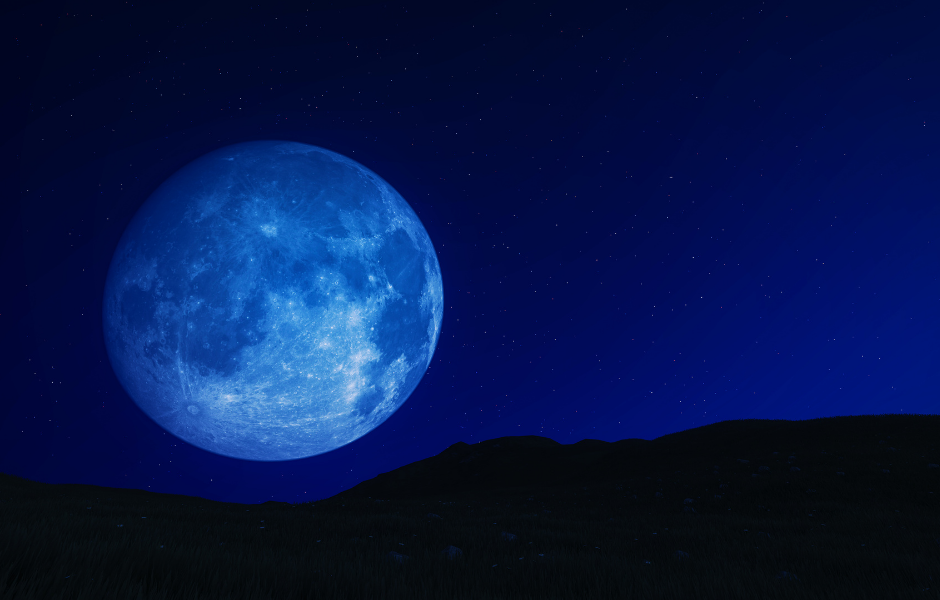
This children’s article, Rare Blue Moon lights up the night sky, has been written for native English speakers and learners of English as a second or foreign language who are interested in space, astronomy, the Moon, and unusual events in the night sky. It can help children practise reading and comprehension, learn useful vocabulary, and discover the meaning of the famous phrase “once in a blue moon”. Written by Sinead O’Carroll, an experienced teacher and writer for young readers.
Rare Blue Moon lights up the night sky
Children and adults around the world may spend a little extra time looking up at the sky tonight. A rare Blue Moon is expected to appear on 31 May, giving skywatchers a chance to enjoy a special full moon.
The name sounds magical. Some people imagine a bright blue Moon glowing above the Earth. The real surprise is that a Blue Moon is usually not blue at all.
What is a Blue Moon?
A Blue Moon is the name given to the second full moon in a single calendar month. Since most months only have one full moon, a Blue Moon is quite rare. Most people see full moons regularly throughout the year, yet a Blue Moon happens much less often.
The Moon itself does not change colour. It will still look silver, white, or pale yellow as it rises into the evening sky.
Even so, many people enjoy spotting a Blue Moon because it feels different from an ordinary full moon. Families, photographers, and astronomy fans often take the opportunity to step outside and look up.
Once in a blue moon
The rarity of a Blue Moon has helped create one of the most famous phrases in the English language.
If something happens “once in a blue moon”, it happens very rarely.
Imagine a child who only visits a faraway cousin every few years. They might say, “I only see my cousin once in a blue moon.”
The phrase does not really mean a blue-coloured Moon appears. It is simply a colourful way of describing something uncommon.
A chance to wonder
Long before telescopes existed, people watched the Moon carefully. They noticed its changing shape and used it to help measure time.
Today, the Moon remains one of the easiest objects in space to observe. No special equipment is needed. A clear sky and a little patience are often enough.
As darkness falls tonight, millions of people may glance upwards and see the same bright Moon shining above them. Some will admire its beauty. Others may remember a phrase they have heard many times before.
A Blue Moon may not look very different from other full moons, yet its unusual timing makes it a fascinating event. That is one reason people still talk about it today, even though it only comes along once in a blue moon.Y
ou can read more about the Moon and lunar science from NASA: Earth’s Moon.
Article vocabulary list
- Skywatchers: People who enjoy looking at the sky and observing objects in space
- Rare: Not common or not seen very often
- Astronomy: The study of space, planets, stars, and other objects in the universe
- Observe: To watch something carefully
- Opportunity: A chance to do something
- Phrase: A group of words that has a particular meaning
- Uncommon: Not usual or not often seen
- Equipment: Tools or items needed for a task
- Patience: The ability to wait calmly
- Fascinating: Extremely interesting
Comprehension questions
Just click the plus (+) to see the answer
1. What special event is expected on 31 May?
a) A meteor shower
b) A Blue Moon
c) A solar eclipse
Answer: b) A Blue Moon
2. What colour is a Blue Moon usually?
a) Blue
b) Green
c) It looks like a normal full moon
Answer: c) It looks like a normal full moon
3. Why is a Blue Moon considered unusual?
a) It changes shape
b) It is a rare extra full moon
c) It only appears in winter
Answer: b) It is a rare extra full moon
4. What does the phrase “once in a blue moon” mean?
a) Something happens very rarely
b) Something happens every month
c) Something happens at night
Answer: a) Something happens very rarely
5. What do people need to enjoy looking at the Moon?
a) A rocket
b) A clear sky and a little patience
c) A powerful telescope
Answer: b) A clear sky and a little patience
6. Why do people still find a Blue Moon interesting?
a) It is always blue
b) It appears during the daytime
c) Its unusual timing makes it special
Answer: c) Its unusual timing makes it special

Sinead is a writer and EFL teacher with eight years’ experience. She’s a native English speaker who loves making news stories fun and easy to understand for children around the world. Her passions include travel, animals, and helping to make the world a kinder, more sustainable place.