This children’s article, Great white shark spotted in the Mediterranean Sea, has been written for native English speakers and learners of English as a second or foreign language. It can help children practise reading and comprehension, learn useful vocabulary, and explore an exciting recent wildlife discovery. Written by Mark Pulley, a teacher and writer who creates fun and informative news articles for English learners.
A rare underwater encounter
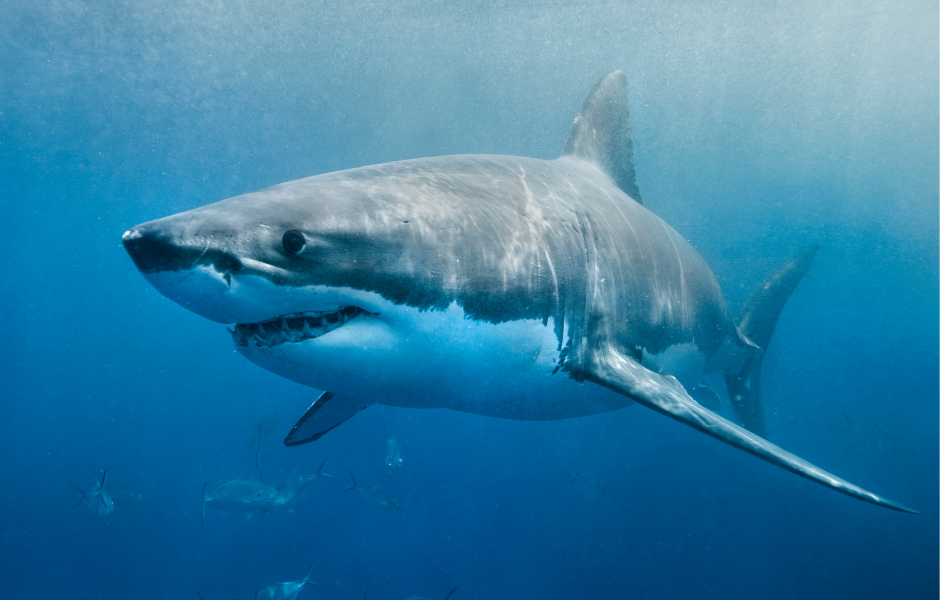
Divers working in the Mediterranean Sea recently made an incredible discovery. While exploring a shipwreck in the Strait of Sicily, between Italy and Tunisia, they came face-to-face with an adult great white shark. The divers were not looking for sharks, they were removing old fishing nets that had been abandoned underwater.
One diver, Derk Remmers, managed to film the animal as it swam near the team. His hands were shaking with excitement as he hurried to switch on his camera. The shark circled briefly before disappearing into the deep blue water.
Why is this sighting so special?
Great white sharks live in oceans around the world, but they are very rarely seen in the Mediterranean Sea. Scientists believe there may be only a few hundred left in the region, making them among the Mediterranean’s most endangered animals.
What made this encounter even more remarkable was that it is believed to be the first time an adult great white shark has been filmed underwater in the Mediterranean. Sharks have been spotted from boats before, but getting such clear underwater footage is extremely unusual.
What is a great white shark?
The great white shark is one of the largest predatory fish on Earth. Some can grow longer than a family car and have hundreds of sharp teeth that are constantly replaced throughout their lives.
Despite their scary reputation in films, great white sharks do not normally hunt humans. Scientists say most encounters happen because the shark is curious or mistakes something for its usual prey. Great whites are important predators that help keep ocean ecosystems healthy.
Protecting these amazing animals
Scientists think overfishing is one reason great white sharks have become so rare in the Mediterranean. Their prey, including tuna, has declined in some areas, making it harder for the sharks to survive. Abandoned fishing gear, like ghost nets, can also trap marine animals.
The recent sighting is a reminder that these magnificent creatures are still out there. Conservation groups hope discoveries like this will encourage people to protect marine habitats so that great white sharks can continue swimming in the Mediterranean for many years to come. Check out our post on World Oceans Day to see how people are helping to save species like the great white shark.
Article vocabulary list
- Mediterranean Sea: A large sea between Europe, Africa and Asia.
- Diver: A person who swims underwater using special equipment.
- Shipwreck: The remains of a ship that has sunk.
- Predator: An animal that hunts other animals for food.
- Endangered: At risk of disappearing forever.
- Ecosystem: A community of living things and their environment.
- Conservation: Protecting nature and wildlife.
- Prey: An animal that another animal hunts.
Comprehension questions
Just click the plus (+) to see the answer
1. Where was the great white shark spotted?
a) The Atlantic Ocean
b) The Mediterranean Sea
c) The Arctic Ocean
Answer: b) The Mediterranean Sea
2. What were the divers doing when they saw the shark?
a) Looking for treasure
b) Studying dolphins
c) Removing old fishing nets
Answer: c) Removing old fishing nets
3. What do conservation groups hope people will do?
a) Protect marine habitats
b) Build more shipwrecks
c) Catch more sharks
Answer: a) Protect marine habitats
4. What is a great white shark?
a) A type of whale
b) A large predatory fish
c) A sea turtle
Answer: b) A large predatory fish
5. Why have great white sharks become rare in the Mediterranean?
a) They have moved to the Moon
b) They only live in rivers
c) Overfishing and other human impacts
Answer: c) Overfishing and other human impacts

Mark is a writer and EFL teacher from England with eight years’ experience. He’s passionate about travel, sport (especially football), animals, nature, and history, and enjoys helping children explore the world through language and learning.