This children’s article, World’s best freediver breaks record again with stunning 126m dive, has been written for native English speakers and learners of English as a second or foreign language. It can help children build vocabulary, learn about extreme sports, and discover how freedivers push the limits of human ability. Written by Mark Pulley, a teacher and writer who creates fun and informative news articles for English learners.
Breaking the record
Imagine holding your breath for over four minutes and diving deeper than the height of a 40-story building. That’s exactly what Russian freediver Alexey Molchanov did in Cyprus at the AIDA Freediving World Championships.
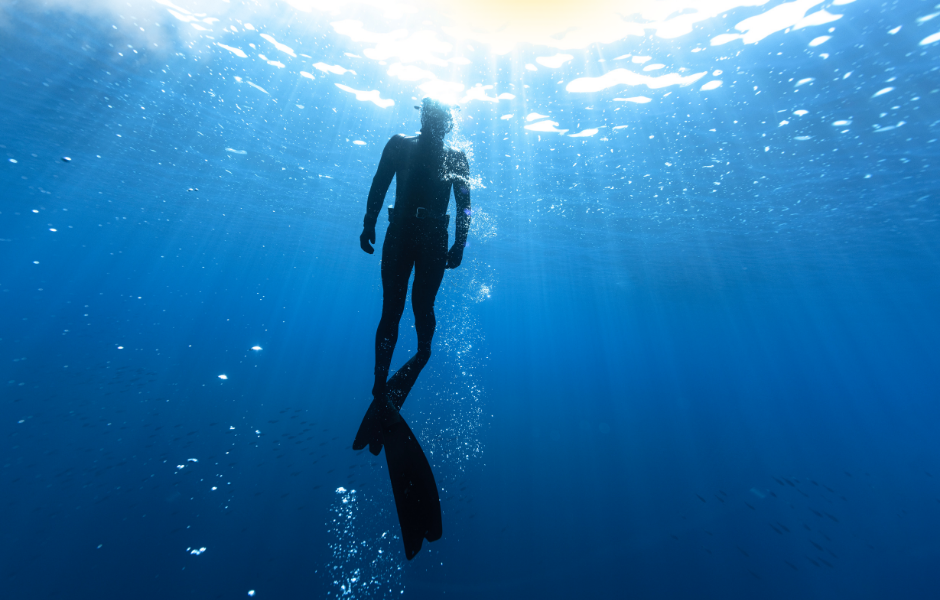
Molchanov plunged 126 metres (413 feet) into the Mediterranean Sea with only a rope for guidance, a headlamp for the darkness, and a pair of fins to power his legs. He had no oxygen tanks to help him, just one big breath. He resurfaced after four minutes and 32 seconds, calmly removing his nose clip and flashing the “okay” hand signal to confirm his dive was successful.
A champion of the deep
This wasn’t Molchanov’s first time making headlines. In fact, he broke his own record of 125 metres, set in 2024. At 37 years old, he is now considered the best freediver in the world, and this dive marked his 40th world record since starting the sport in 2004.
Freediving isn’t just about being a great swimmer; it’s about control, technique, and staying calm even as the pressure builds underwater. Molchanov has mastered all of these things, and his achievements have made him a legend in the sport. The crowd in Limassol celebrated loudly when he resurfaced, recognising just how extraordinary his feat was.
Why is it so difficult?
Diving this deep without breathing equipment is one of the toughest challenges in freediving. The deeper you go, the more the water pressure squeezes your body and lungs. At over 100 metres deep, the pressure is more than ten times what we feel at the surface. Divers must also fight the natural urge to breathe, staying relaxed and focused until they return to daylight.
Molchanov has trained for years to control his mind and body in these extreme conditions. Every record adds to his long list of achievements and shows what humans can do when they push their limits.
What is freediving?
Freediving is an underwater sport where divers hold their breath rather than using scuba tanks. There are many different types of freediving, such as swimming horizontally in a pool, plunging straight down into the sea, or even diving under ice.
The challenge is to stay calm, conserve energy, and control your breathing before and after the dive. Some freedivers train their lungs to hold air for five, six, or even more minutes. Others practise equalising the pressure in their ears so they can dive deeper without pain.
Freediving is often described as extremely peaceful because divers move quietly without making bubbles or using machines. But it also demands great discipline and training, which is why records like Molchanov’s are so remarkable.
Article vocabulary list
- Freediving: Diving underwater while holding your breath, without oxygen tanks.
- Record: The best or highest achievement in a sport.
- Fins: Flippers worn on the feet to swim faster.
- Pressure: The force of water or air pushing on something.
- Resurface: To come back up to the top of the water.
- Technique: A special way of doing something well.
- Conserve: To save or use carefully.
- Discipline: Self-control and training to follow rules or stay focused.
Comprehension questions
Just click the plus (+) to see the answer
1. How deep did Alexey Molchanov dive to set his new record?
A) 100 metres
B) 125 metres
C) 126 metres
Answer: C) 126 metres
2. How long did Molchanov hold his breath during the record dive?
A) 3 minutes and 10 seconds
B) 4 minutes and 32 seconds
C) 5 minutes and 20 seconds
Answer: B) 4 minutes and 32 seconds
3. What equipment did Molchanov use during his dive?
A) Scuba tanks and a mask
B) A rope, a headlamp, and fins
C) Just his swimsuit
Answer: B) A rope, a headlamp, and fins
4. Why is freediving at great depth so difficult?
A) Because it’s very dark
B) Because of high water pressure and lack of oxygen
C) Because the water is always freezing
Answer: B) Because of high water pressure and lack of oxygen
5. How many world records has Molchanov set in freediving?
A) 20
B) 30
C) 40
Answer: C) 40

Mark is a writer and EFL teacher from England with eight years’ experience. He’s passionate about travel, sport (especially football), animals, nature, and history, and enjoys helping children explore the world through language and learning.