This children’s article, The history of human migration explained for kids, has been written for native English speakers and learners of English as a second or foreign language. It helps children understand where humans first came from, how people slowly spread across the world, and how those journeys still shape life on Earth today. Written by Mark Pulley, a teacher and writer who creates fun and informative news articles for English learners.
The first humans in Africa
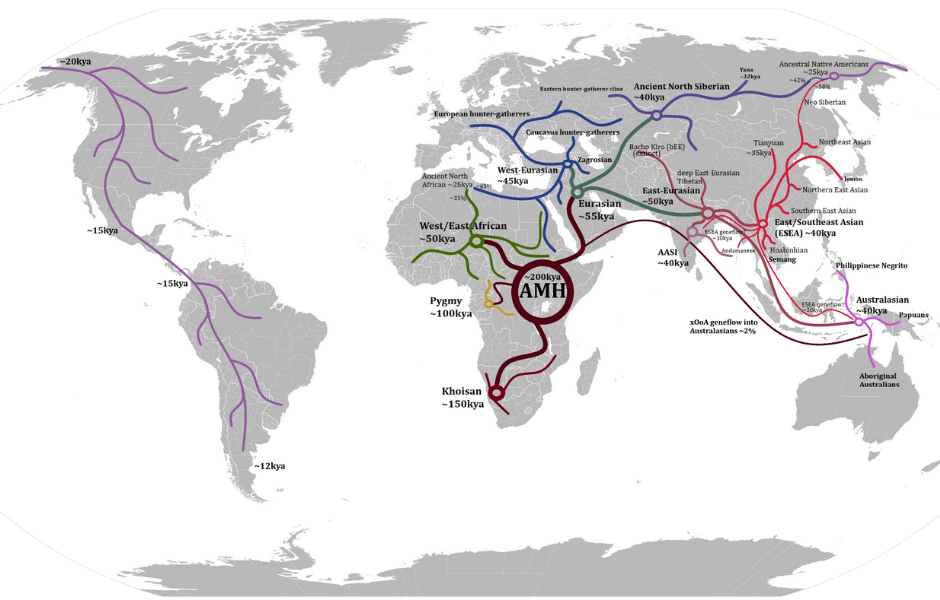
The story of human migration begins in Africa. Scientists believe the earliest humans appeared there around 300,000 years ago. These early people lived in small groups, hunting animals and gathering plants to survive.
Life was closely tied to nature. When food became scarce or the climate changed, groups often moved short distances to find better places to live. Over many thousands of years, these small movements slowly added up to something much bigger.
Africa is sometimes called the “birthplace of humanity” because every human alive today can trace their family history back to these early African ancestors.
Moving into new lands
Around 70,000 years ago, some groups began moving out of Africa. They travelled into the Middle East and then slowly spread into Asia and Europe. These journeys were not planned expeditions. Families and small tribes simply moved a little further than the generation before them.
People followed animals, rivers, coastlines, and familiar landscapes. They settled where food and shelter were available, then moved on again when conditions changed. Over time, humans learned to survive in cold, hot, wet, and dry environments.
These early migrants adapted their tools, clothing, and shelters to suit each new place they reached.
Reaching the last continents
Humans eventually reached Australia by travelling short sea routes, likely using simple boats. Much later, during the last Ice Age, people crossed from Asia into North America using a frozen land bridge.
From there, groups continued south, spreading through North America and eventually reaching South America. This made South America the last continent to be settled by humans.
Once again, this did not happen all at once. Each group moved gradually, setting up new communities just beyond the lands already occupied by others.
A world shaped by people
Today, humans live on nearly every part of Earth. Cities, farms, roads, and towns cover most of the land. Scientists estimate that only about 23% of Earth’s land, excluding Antarctica, remains mostly wild and free from direct human change.
When researchers look more closely at truly untouched ecosystems, the number becomes even smaller. Only around 3% of Earth’s land still contains all its original plants and animals in a healthy, natural balance.
Human migration helped people survive and thrive, but it also changed the planet forever. Understanding this long journey helps us think carefully about how we care for the world today.
Article vocabulary list
- Migration: The movement of people from one place to another.
- Ancestors: Family members from long ago.
- Tribe: A small group of people living and working together.
- Ice Age: A very cold period in Earth’s history.
- Land bridge: A strip of land that once connected two continents.
- Ecosystem: A community of plants and animals living together.
Comprehension questions
Just click the plus (+) to see the answer
1. Where did the earliest humans first live?
a) Europe
b) Asia
c) Africa
Answer: c) Africa
2. Why did early humans move from place to place?
a) To build large cities
b) To find food and better living conditions
c) To explore for fun
Answer: b) To find food and better living conditions
3. How did most early migration happen?
a) Through planned journeys
b) By small groups moving gradually
c) Using maps and compasses
Answer: b) By small groups moving gradually
4. Which continent was settled last by humans?
a) Australia
b) Europe
c) South America
Answer: c) South America
5. About how much of Earth’s land is still mostly wild today?
a) Around 23%
b) Around 50%
c) Around 75%
Answer: a) Around 23%

Mark is a writer and EFL teacher from England with eight years’ experience. He’s passionate about travel, sport (especially football), animals, nature, and history, and enjoys helping children explore the world through language and learning.