This children’s article, Nuclear weapons explained: History, danger and hopes for the future, has been written for native English speakers and learners of English as a second or foreign language. It can help children practise reading and comprehension, learn useful vocabulary, and understand an important topic often discussed in world news. Written by Mark Pulley, a teacher and writer who creates fun and informative news articles for English learners.
What is a nuclear weapon?
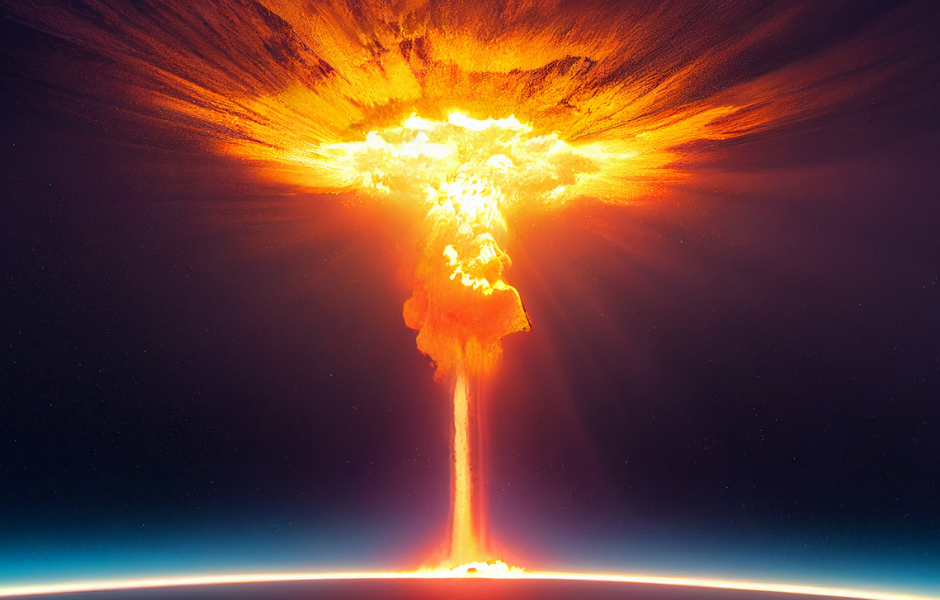
A nuclear weapon is an extremely powerful bomb. It releases energy from the centre of atoms, which are tiny particles that make up everything around us. When this energy is released all at once, it creates a huge explosion.
Nuclear explosions can destroy entire cities and cause long-lasting harm to people and the environment. Because of their destructive power, nuclear weapons are very different from ordinary weapons.
They are sometimes called atomic bombs or nuclear bombs.
When were they first built and used?
Nuclear weapons were first developed during the Second World War. A group of scientists in the United States worked on a secret project called the Manhattan Project. One of the leading scientists was J. Robert Oppenheimer.
In August 1945, the United States dropped atomic bombs on the Japanese cities of Hiroshima and Nagasaki. These were the only times nuclear weapons have been used in war. The explosions caused massive destruction and loss of life, and Japan surrendered shortly afterwards.
The horror of these events shocked the world and changed history forever.
The Cold War and the arms race
After the war, tensions grew between the United States and the Soviet Union. This period was known as the Cold War. Both countries built thousands of nuclear weapons in what became known as an arms race.
The Soviet Union broke apart in 1991, and Russia inherited most of its nuclear weapons. Even after agreements to reduce stockpiles, the United States and Russia still have the largest number of nuclear weapons today.
Which countries have nuclear weapons today?
Today, nine countries are believed to have nuclear weapons. These include the United States, Russia, China, France, the United Kingdom, India, Pakistan, North Korea and Israel.
Many countries say they keep nuclear weapons as a deterrent. A deterrent is something meant to stop others from attacking. The idea is that if two countries both have nuclear weapons, neither will want to start a war because the consequences would be devastating.
How are they tested and controlled?
In the past, nuclear weapons were tested by exploding them underground, underwater or in the atmosphere. These tests helped scientists understand how the weapons worked, but they also caused environmental damage.
Today, most nuclear testing has stopped. Many countries have signed agreements promising not to test nuclear weapons. Scientists now use computer simulations instead of real explosions. There are also international treaties that aim to limit and reduce nuclear weapons.
Hopes for a safer future
Around the world, many people hope for a future without nuclear weapons. Some countries have agreed to reduce their stockpiles, and global organisations work towards disarmament.
Disarmament means reducing or completely getting rid of these weapons. Supporters believe that cooperation, trust and strong international agreements are the best ways to prevent nuclear war.
Although nuclear weapons still exist, many leaders and citizens continue to work towards a more peaceful and safer world.
Article vocabulary list
- Atom: A tiny particle that makes up everything in the universe.
- Atomic bomb: A bomb that releases energy from atoms.
- Arms race: A competition between countries to build more and stronger weapons.
- Deterrent: Something that discourages someone from taking action.
- Stockpile: A large stored supply of weapons or goods.
- Treaty: A formal agreement between countries.
- Disarmament: The reduction or removal of weapons.
Comprehension questions
Just click the plus (+) to see the answer
1. What makes a nuclear weapon different from ordinary weapons?
A) It is smaller
B) It releases energy from atoms in a massive explosion
C) It makes no noise
Answer: B) It releases energy from atoms in a massive explosion
2. In which year were nuclear weapons first used in war?
A) 1939
B) 1945
C) 1962
Answer: B) 1945
3. Which two countries have the largest number of nuclear weapons today?
A) The United States and Russia
B) China and India
C) France and Germany
Answer: A) The United States and Russia
4. What is a deterrent?
A) A type of missile
B) A peace treaty
C) Something meant to prevent an attack
Answer: C) Something meant to prevent an attack
5. What does disarmament mean?
A) Building more weapons
B) Reducing or removing weapons
C) Testing new bombs
Answer: B) Reducing or removing weapons

Mark is a writer and EFL teacher from England with eight years’ experience. He’s passionate about travel, sport (especially football), animals, nature, and history, and enjoys helping children explore the world through language and learning.