This children’s article, A rare planetary parade lights up the night sky, has been written for native English speakers and learners of English as a second or foreign language. It can help children build vocabulary, learn about space and astronomy, and understand how special events happen in our night sky. Written by Mark Pulley, a teacher and writer who creates fun and informative news articles for English learners.
What is going to happen?
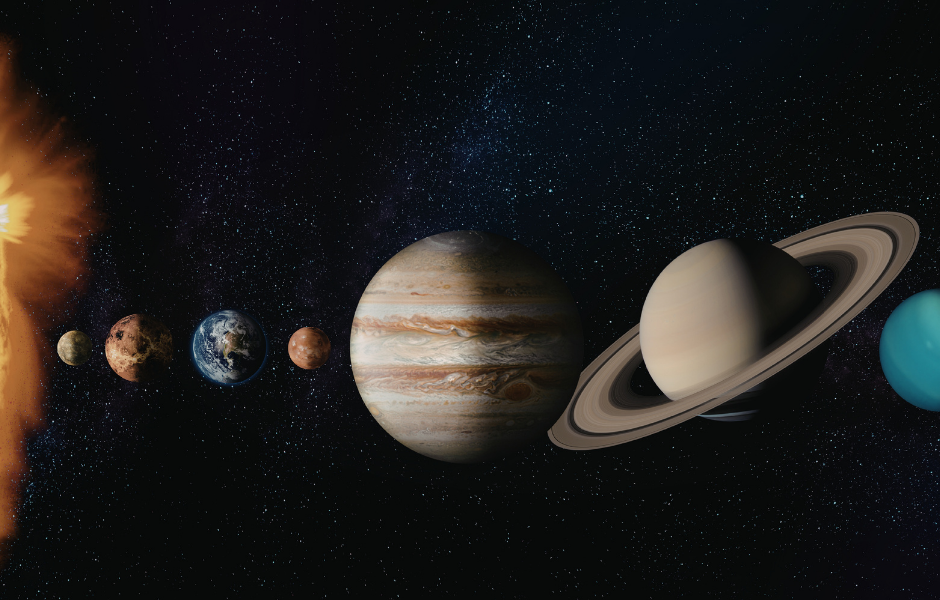
In late February, sky watchers around the world are enjoying a rare and exciting space event. Six planets from our solar system are appearing in the sky at the same time in what scientists call a planetary parade.
This is a wonderful chance for children and families to look up, explore space, and learn more about the planets that travel around our Sun.
What is a planetary parade?
A planetary parade happens when several planets appear lined up across the sky when seen from Earth. They are not actually in a straight line in space, but from our viewpoint, they seem neatly arranged.
This event is quite rare, especially when so many planets can be seen together, which makes it a very special moment for sky watchers.
During this parade, six planets are visible: Mercury, Venus, Mars, Jupiter, Saturn and Uranus. Venus and Jupiter are the easiest to spot because they shine very brightly, while Mars looks like a small reddish dot.
Mercury is harder to see because it stays close to the Sun, and Uranus is the most difficult of all because it’s so far away, so you’ll probably need binoculars or a telescope to see it.
When and where should you look?
The best time to look is just after sunset, on or around February 28th. Find a place away from bright lights, with a clear view of the horizon.
Looking towards the west often works best. With patience and careful watching, more planets may slowly appear.
Why is this event so special?
Planetary parades help scientists understand how planets move and travel through space. They also inspire people to become curious about astronomy and the universe.
For children, it is a fun way to connect science with real-life observation, showing that space is not just something in books, but something we can see with our own eyes.
Article vocabulary list
- Planet: A large object in space that travels around a star.
- Solar system: The Sun and everything that moves around it.
- Parade: A line or group of things appearing together.
- Horizon: The line where the land or sea seems to meet the sky.
- Astronomy: The study of space, stars, and planets.
- Binoculars: A tool that makes far-away objects look closer.
- Observation: Watching something carefully to learn more about it.
- Orbit: The curved path an object follows around another object in space.
Comprehension questions
Just click the plus (+) to see the answer
1. What is a planetary parade?
a) When planets crash into each other
b) When several planets appear lined up in the sky
c) When the Moon blocks the Sun
Answer: b) When several planets appear lined up in the sky
2. Which planet is the brightest and easiest to see?
a) Venus
b) Uranus
c) Mercury
Answer: a) Venus
3. When is the best time to look for the planets?
a) Early morning
b) At midday
c) Just after sunset
Answer: c) Just after sunset
4. Which planet is the hardest to see without special equipment?
a) Saturn
b) Mars
c) Uranus
Answer: c) Uranus
5. Why is this event special?
a) Because many planets can be seen at the same time
b) Because planets stop moving
c) Because it happens every night
Answer: a) Because many planets can be seen at the same time

Mark is a writer and EFL teacher from England with eight years’ experience. He’s passionate about travel, sport (especially football), animals, nature, and history, and enjoys helping children explore the world through language and learning.