This children’s article, From ice and Vikings to modern life: the history of Greenland, has been written for native English speakers and learners of English as a second or foreign language. It helps children learn about the first people to live in Greenland, who has controlled the island over time, and what life is like there today. Written by Mark Pulley, a teacher and writer who creates fun and informative news articles for English learners.
The first people in Greenland
Greenland’s human history began thousands of years ago. The first people arrived around 4,500 years ago, travelling from North America across icy land and sea. These early groups were skilled hunters who learned how to survive in one of the coldest places on Earth.
They hunted animals such as seals and whales, using simple tools made from stone, bone, and wood. Warm clothing and strong shelters were essential, and knowledge was passed down through families over many generations.
These early settlers are the ancestors of today’s Inuit people, who still live across Greenland
Vikings and European explorers
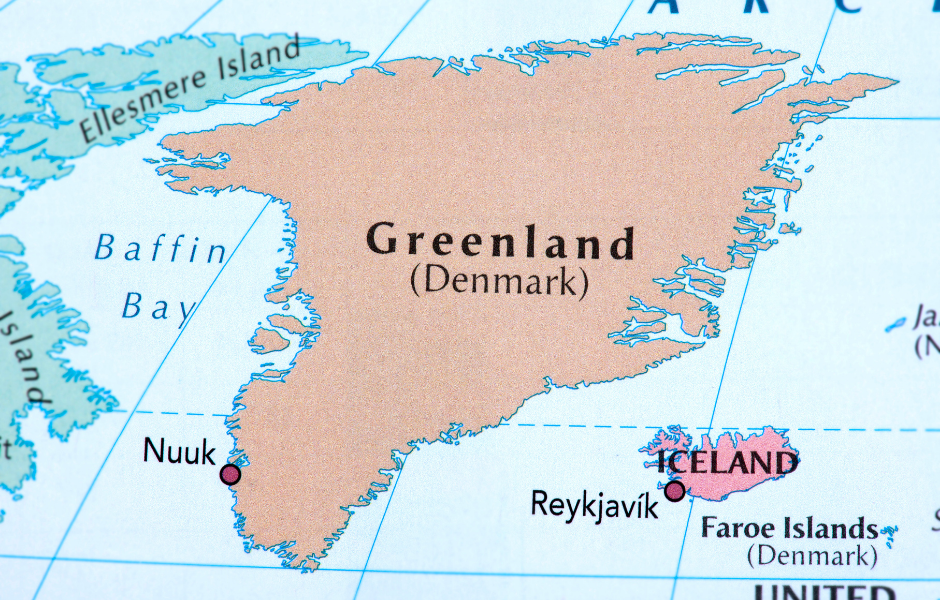
Around the year 985, Viking settlers from Iceland arrived in Greenland, led by Erik the Red. They set up farming communities along the warmer southern coast, raising animals and growing small crops during the short summers.
At this time, Greenland was linked to the Kingdom of Norway. For several centuries, Greenland was considered part of the Norwegian world, even though it was very far away. Over time, the Viking settlements disappeared, likely due to colder weather, food shortages, and isolation. When Norway later entered a union with Denmark, Greenland became connected to Denmark as well, even though very few Europeans lived there at the time.
In 1814, when Norway and Denmark officially separated, Greenland remained under Danish control. This agreement helped confirm Denmark’s role in governing the island.
Who lives in Greenland today
Today, Greenland has a population of about 56,000 people. Most live in small towns and villages along the coast, where the sea provides food and travel routes. The capital city is Nuuk, which is the largest settlement on the island.
Inuit culture is still very strong. Many people speak Greenlandic as their first language, alongside Danish. Traditional activities such as fishing, hunting, and dog sledging remain important, even as modern technology becomes more common.
Life in Greenland often means adapting to long, dark winters, bright summer nights, and extreme weather.
Why Greenland is a special place
Greenland is the world’s largest island, and most of it is covered by a huge ice sheet. This ice holds valuable information about Earth’s past climate, making Greenland important for scientific research.
The island is also special because of its wildlife, landscapes, and culture. Glaciers, fjords, and icebergs shape the land, while strong traditions shape daily life.
Greenland’s value comes not just from its size, but from its history, people, and role in helping us understand our planet.
Article vocabulary list
- Inuit: Indigenous people who live in Arctic regions.
- Settlers: People who move to a new place to live.
- Isolation: Being far away from other places or people.
- Fjord: A long, narrow sea inlet between cliffs.
- Ice sheet: A very large area of thick ice covering land.
- Culture: The traditions, language, and way of life of a group of people.
Comprehension questions
Just click the plus (+) to see the answer
1. Who were the first people to live in Greenland?
a) Vikings
b) Inuit ancestors
c) Danish explorers
Answer: b) Inuit ancestors
2. Why was survival difficult for early Greenland settlers?
a) Because of extreme cold and limited food
b) Because of too many people
c) Because there were no animals
Answer: a) Because of extreme cold and limited food
3. Who led the Viking settlers to Greenland?
a) Leif Erikson
b) Erik the Red
c) Harald Bluetooth
Answer: b) Erik the Red
4. Where do most people in Greenland live today?
a) In the centre of the island
b) Along the coast
c) On the ice sheet
Answer: b) Along the coast
5. Why is Greenland important to scientists?
a) It has many cities
b) Its ice shows Earth’s climate history
c) It grows lots of crops
Answer: b) Its ice shows Earth’s climate history

Mark is a writer and EFL teacher from England with eight years’ experience. He’s passionate about travel, sport (especially football), animals, nature, and history, and enjoys helping children explore the world through language and learning.