
This children’s article, A kid’s guide to the dazzling world of diamonds, has been written for native English speakers and learners of English as a second or foreign language. It can help children build vocabulary, learn about geology, jewellery, and famous discoveries, and develop their reading comprehension. Written by Mark Pulley, a teacher and writer who creates fun and informative news articles for English learners.
What is a diamond?
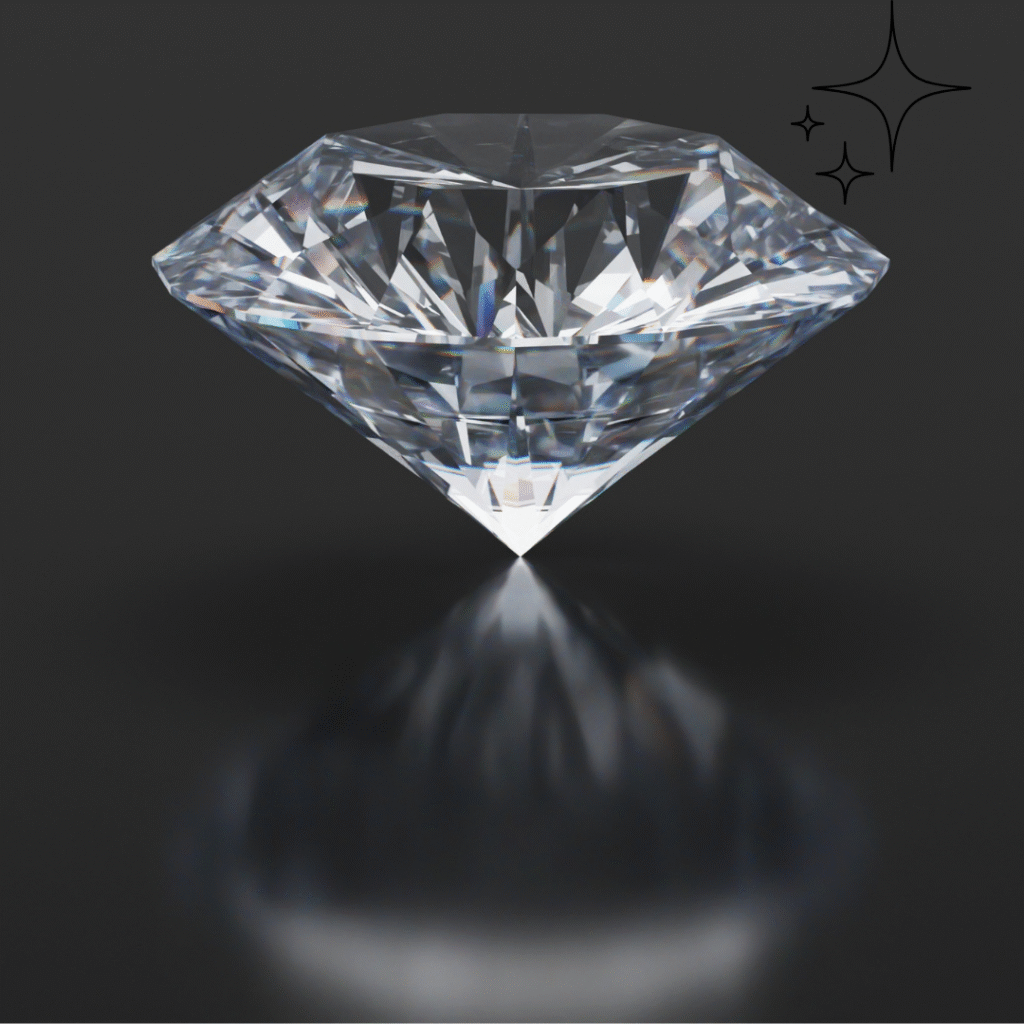
Diamonds are the hardest natural material on Earth. They’re a type of crystal made entirely of carbon, the same element found in charcoal and pencil lead! But unlike those soft, black materials, diamonds form deep underground under extreme heat and pressure, turning carbon into something sparkly and strong
How are diamonds made?
Diamonds form way down under the surface of the Earth. About 150 kilometres below, where the temperature can reach over 1,000°C. That’s where carbon can slowly turn into diamonds. And it takes a really long time. Some of the oldest diamonds are around 3.9 billion years old.
If they stayed that far below the ground, we wouldn’t be able to get them. Luckily, powerful volcanic eruptions push them closer to the surface, where people can eventually dig them up.
Scientists have recently managed to make diamonds in laboratories using heat and pressure. Some people don’t think they are real diamonds because they’re not natural. What do you think?
Why are diamonds so popular?
Diamonds are famous for their beauty and sparkle. They’re often in rings, necklaces and crowns. But diamonds aren’t just pretty, they’re also useful. They’re so hard, they can cut through metal and rock! Some drills and saws use tiny diamond tips for super-tough jobs.
Still, it’s that glittering sparkle that makes these gems special to most people.
The biggest and most valuable diamonds
The largest diamond ever found is the Cullinan Diamond, which was discovered in South Africa in 1905. It weighed an incredible 3,106 carats, that’s over half a kilogram! It was cut into many smaller gems, some of which now sit in the British Crown Jewels.
One of the most expensive diamonds in the world today is the Pink Star Diamond. It’s a rare, pink-coloured gem that sold for over $70 million in 2017.
There are even diamonds in space! Some stars that have burned out leave behind diamond-like cores. One of them is even nicknamed “Lucy” after a famous song by the Beatles: Lucy in the Sky with Diamonds.
If you want to see some of the most amazing diamonds, you should check out the British Crown Jewels.
Article vocabulary list
- Crystal – A solid material with flat sides and a regular shape.
- Carbon – A chemical element found in all living things.
- Pressure – A force that’s pushed against something.
- Laboratory – A place where scientists work and do experiments.
- Symbol – Something that represents an idea or feeling.
- Carat – A unit used to measure how heavy a gemstone is.
- Gem – A precious stone that is usually cut and polished.
- Crown Jewels – Special jewels worn by kings and queens.
- Rare – Very unusual or hard to find.
- Mineral – A natural substance found in rocks or the Earth.
Comprehension questions
Just click the plus (+) to see the answer
1. What are diamonds made of?
A) Water
B) Carbon
C) Salt
Answer: B) Carbon
2. How do diamonds form underground?
A) From frozen water
B) From wind and sand
C) From heat and pressure on carbon
Answer: C) From heat and pressure on carbon
3. Why are diamonds used in drills and saws?
A) Because they are shiny
B) Because they are colourful
C) Because they are very hard
Answer: C) Because they are very hard
4. What is the name of the largest diamond ever found?
A) Cullinan Diamond
B) Lucy Diamond
C) Pink Star Diamond
Answer: A) Cullinan Diamond
5. How old can some diamonds be?
A) A few thousand years
B) A few million years
C) Over 3 billion years
Answer: C) Over 3 billion years

Mark is a writer and EFL teacher from England with eight years’ experience. He’s passionate about travel, sport (especially football), animals, nature, and history, and enjoys helping children explore the world through language and learning.